
One in four freelancers working in IT relies on permanent collaboration and long-term projects. Every second one is a man aged 25-34. Nearly one in five earns more than £1,900 per month net. Although amounts exceeding £3,200 in pay are also not uncommon, despite — or perhaps because of — the pandemic.
There is probably no other area of freelance work more associated with prestige and high earnings than programming and IT broadly understood. The fact that this group attracts great interest also among people outside the industry is evidenced by, among other things, the number of stereotypes circulating about programmers online, as well as the number of search engine queries about their earnings. That is why Useme.com decided to survey this group of freelancers to dispel any doubts.
Who Are They?
Who are Polish freelance programmers?
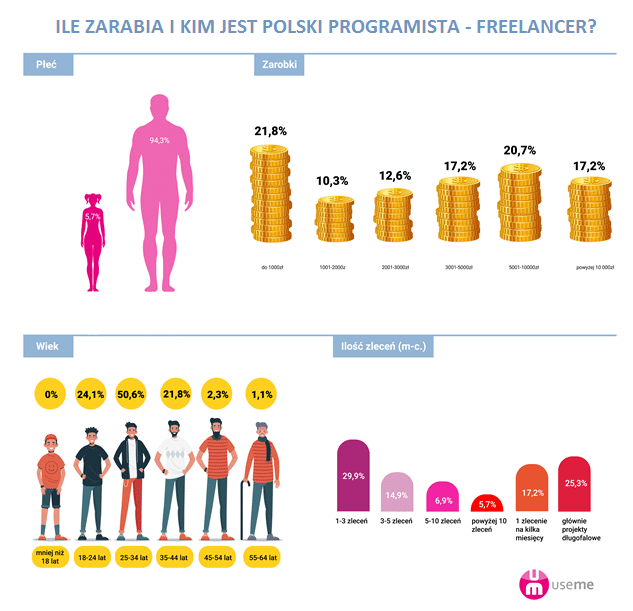
IT is a field dominated by men worldwide. This rule also applies to Poland and to the segment of this professional group that specializes in carrying out freelance orders. Useme's research shows that they account for as many as 94.3% of respondents, compared to 5.7% women. Among freelance programmers, the largest group (50.6% of those surveyed) are young people, i.e., those aged 25-34. In second place (28.1%) are somewhat older freelancers, i.e., those aged 35-44, while those aged 18-24 are represented by one in four (24.1%) respondents. The smallest age groups among programmers are 45-54 (2.3%) and 55-64 (1.1%).
How Much Does a Polish Freelance Programmer Earn?
How much does a Polish freelance programmer earn?
This aspect of Polish programmers' work probably attracts the greatest interest and, consequently, the most emotion. IT is traditionally the professional group with the highest earnings on the market. Of course, pay depends on several factors, i.e.: experience, including the number of completed projects and their level of complexity or scope of work, specialization, the strength of one's personal brand — or in other words, the freelancer's rating on freelance platforms — as well as the number and quality of references. One should also take into account whether the freelancer supports themselves solely through freelancing or merely earns extra income from it. Useme's research shows that for nearly half (49.5%) of respondents, freelancing is their only form of earning, while for the remaining 50.5% it is a way of supplementing income from full-time employment or another main occupation.
In the surveyed group, every third (32.1%) programmer surveyed declared that they earn up to PLN 3,000 per month from freelancing (approximately £570). Typically, such earnings go to younger specialists or junior programmers who work part-time while studying at university, or to freelancers who supplement their main professional occupation with orders. In turn, pay of PLN 3,000-5,000 (approximately £570-£950) is received by 17.2% of Polish IT specialists working as freelancers. Nearly every fourth freelancer earns more than PLN 5,000 per month (approximately £950), of which 20.7% of respondents earn in the range of PLN 5,000-10,000 (approximately £950-£1,900), and 17.2% earn more than PLN 10,000 per month net (approximately £1,900). In this group, earnings exceeding PLN 15,000 (approximately £2,850) are increasingly common, and often even PLN 17,000 (approximately £3,230). This is a significant difference compared to other groups of freelancers in our country, for whom pay above PLN 10,000 is not the standard. It should be noted, however, that the highest earnings are reserved for experienced experts in rare areas of IT, e.g., iOS mobile developers or advanced IT systems architects.
Women freelancers who are IT specialists unfortunately earn less than their male colleagues. Women earning more than PLN 10,000 per month (approximately £1,900) account for only 1% of surveyed freelancers, while men account for 5%. In the PLN 5,000-10,000 range (approximately £950-£1,900), women represent only 7%, while men represent 11% of respondents.


