THE SEVEN DEADLY SINS OF CUSTOMER SERVICE
In today's world, customer experience increasingly influences customer behaviour, and that behaviour determines a company's success. We are also seeing the product itself matter less to the customer, while the value of the experience of being a customer grows. As a result, companies are placing ever greater emphasis on differentiating themselves not only through the product itself, but also through service quality and customer experience management. Nevertheless, companies still make mistakes.
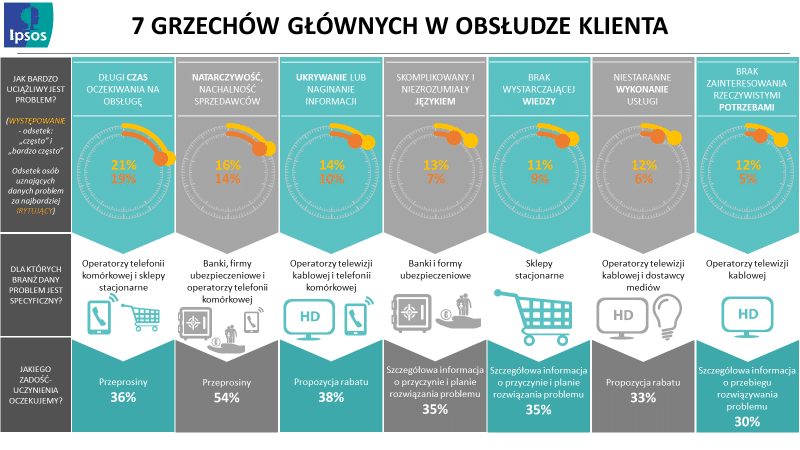
Ipsos, in a study carried out in May 2019, set out to find which service sins Polish consumers encounter most often. Which company behaviours irritate them the most, which industries lead in committing these mistakes, and what kind of redress customers expect.
WHICH SERVICE MISTAKES ARE THE MOST BURDENSOME?
The most common sins against the customer
The most frequently reported problem is long waiting times for service – one in five consumers encounters it often or very often. In an era when time has become one of the most precious and, at the same time, most limited resources, it is hardly surprising that this situation is rated as highly irritating.
Further down the ranking of the most frequently experienced and most irritating service problems were pushiness and aggressiveness on the part of salespeople, as well as hiding or stretching information related to the offer. The first of these problems in particular may be a consequence of unwanted telemarketing.
EVERY INDUSTRY HAS ITS OWN INDIVIDUAL PROBLEMS IN CUSTOMER SERVICE
Industries and their specific mistakes
Customer service problems show a certain industry-specific character. The problem of communicating in a clear and accessible way is primarily the domain of the financial sector – it is mainly banks and insurers that are accused of using overly specialised language. Mobile phone and cable TV operators are more often associated with hiding or stretching information related to the offer. The latter are also associated with careless performance of the service. Meanwhile, a lack of sufficient knowledge about products and services is primarily the domain of salespeople in bricks-and-mortar stores.
YOU DON'T ALWAYS HAVE TO PAY FOR MISTAKES – SOMETIMES AN APOLOGY IS ENOUGH
An apology is enough instead of compensation
Interestingly, most of the most common sins of service providers do not require companies to make significant financial outlays in order to improve customer satisfaction and save the relationship.
For the most serious and most irritating problems – that is, long waiting times and pushy salespeople – customers simply expect an apology from the company.
Using overly specialised language, failing to focus on the customer's real needs, or insufficient knowledge on the part of the person providing service are sins that the consumer is willing to forgive the company if they receive information about the causes of the problem and a plan for fixing it.