
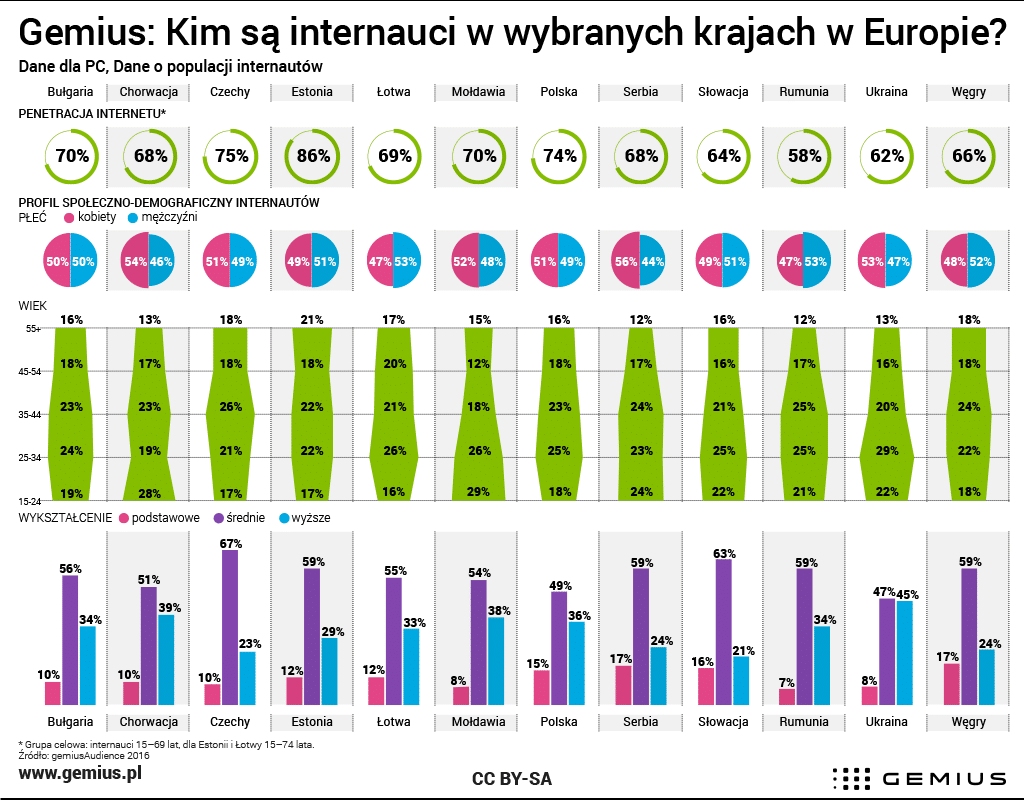
In Estonia, internet users (PC) make up 86% of the population, 75% in the Czech Republic, and 74% in Poland. How do these statistics look in other countries? Check and compare the latest Gemius data on internet users across different markets.
Who uses the internet in 12 European countries
Gemius examined who uses the internet in 12 European countries. The report covers: Bulgaria, Croatia, Czech Republic, Estonia, Latvia, Moldova, Poland, Serbia, Slovakia, Romania, Ukraine, and Hungary. Analyzed data provide insights into who internet users are and what percentage of the population they represent in each country.
Estonians most internet-connected
Internet reach: Estonia ahead of Czech Republic and Poland
According to estimates, Estonia has the highest proportion of internet users among its population—at 86% (source: gemiusAudience). The Czech Republic and Poland follow closely. Only one in four people aged 15–69 in these countries do not use the internet. In contrast, Romania has the lowest proportion of internet users at 58%.
More female users on the Balkans
Gender imbalances on the Balkans
Countries showing the most significant gender imbalances in internet user structure are Serbia, Croatia, Romania, and Latvia. In both Romania and Latvia, men make up 53% of internet users. Meanwhile, in Serbia and Croatia, women outnumber men by even more percentage points. Serbian women account for 56% of internet users in their country, while Croatian women make up 54%.
Most young users in Moldova, most over 55 in Estonia
Age and education of European internet users
According to Gemius data, Moldova is the country where individuals aged 15–24 account for the largest share of internet users—29%. In Ukraine, the largest age group is 25–34 years old—29%. Who are internet users in other countries? One in four Czech internet users is aged 35–44, one in five Latvians is 45–54, and one in five Estonians is 55 or older.
Internet users mostly have secondary education
Who are European internet users in 12 European countries?
In all analyzed countries, the largest group of internet users has secondary education. The Czech Republic leads this category, where this group makes up 67% of internet users. Ukraine has the highest share of internet users with higher education—45%. Meanwhile, Slovakia has the lowest proportion of users with a university diploma—at 21%.
The analysis covers traffic from personal computers (PC).
Summary
Gemius data shows that in the 12 analyzed countries, the majority of internet users have secondary education—67% in the Czech Republic. Ukraine has the highest proportion of internet users with higher education (45%), while Slovakia has the lowest (21%).
The report also reveals generational differences: in Moldova, the largest group is aged 15–24 (29%), while in Estonia, one in five internet users is 55 or older. The study covers PC-based internet traffic.


