Company boards increasingly recognize that positive customer experiences with their brand give them an edge over competitors. For this reason, marketing strategies planned for the coming years are largely based on Customer Experience.
Combining technology, the digital and analog worlds, people, processes, as well as goals and success metrics is not easy at all. Especially when the customer's well-being is at stake. Unfortunately, marketing is increasingly perceived anachronistically. Very often the first thought that comes to mind is costs, not profits or growth, and the first reflex in a crisis situation is to cut marketing costs.
This is a good moment to introduce 3 fundamental changes in the perception of marketing!
Marketing is not an ad break
Marketing is not an ad break
The truth is that in most cases it is precisely the marketing department that can work wonders. It is marketing that has the competences, budget, tools and the connection to the consumer to manage every touchpoint between the customer and the organization and to build brands that consumers love. The key principle is to avoid a situation in which responsibility is dispersed, which ultimately means it is not subject to any control. Marketing is not just a producer of online banners and a form of communication with the customer. It is also, or rather above all, the product, the customer experience, the value for the consumer and their service all at once. Working with the customer must be cyclical, not linear, and their needs should be taken into account regardless of circumstances. Finally, it is worth adding that good "customer experience" cannot be built without "employer experience", because every employee is responsible for what customers receive.
Technology in marketing combined with building customer experience
Technology and data in marketing
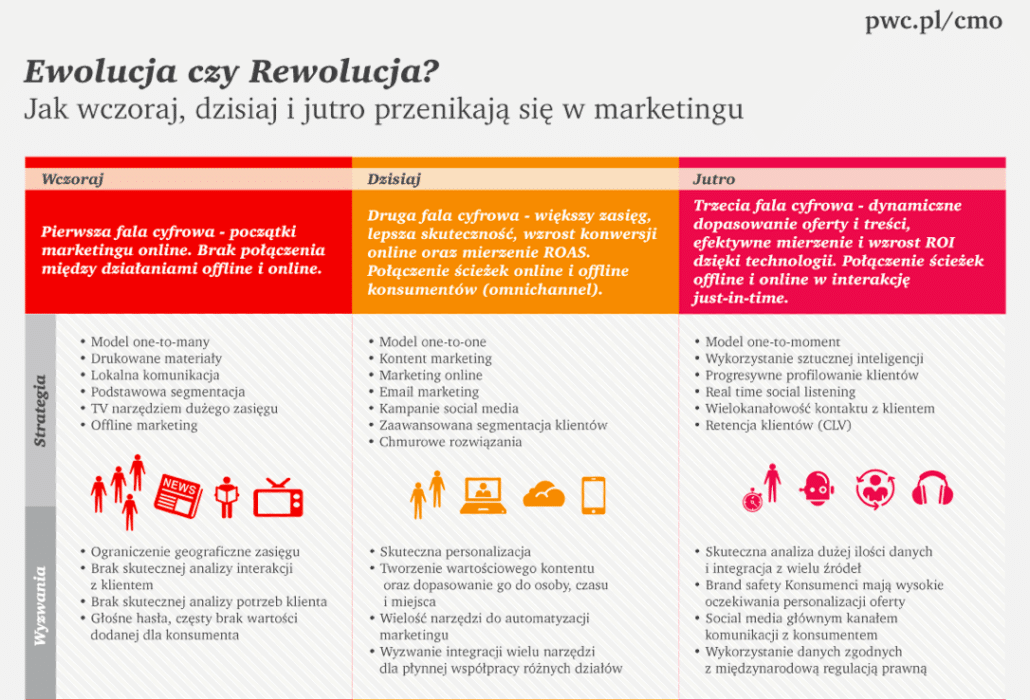
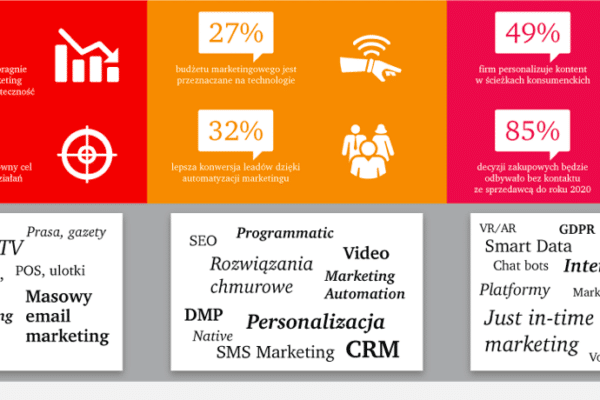
Considering that in 2016 the number of available marketing solutions grew by 4,000, and a year later reached as many as 5,500, this proves that technology contributes significantly to dynamic development. It is worth noting that marketing is not only art, but above all data and technologies.
An appropriately built team implements innovations and sets trends, in a constantly changing and widely available environment of technological solutions, only on condition that it is fast and flexible.
For technology to serve and support the area of customer interaction, a balance between soft, research and humanistic competences is essential.
There is no doubt that technology has revolutionized the possibilities of marketing activities. Unlimited access to the internet and mobile devices have made brands communicate with their customers more and more often, which undoubtedly strengthens bilateral relations. And although it might seem that this is enough, this area is constantly evolving. Marketers are constantly looking for new solutions to reach their consumers.
Communication with the customer is no longer just creating ads for demographically broadly defined target groups, but also precise behavioral targeting of tailored content, and even sending personalized messages that can be emitted at a specific decision-making moment for the consumer. This proves that innovation and the transformation that follows it result from changes in the way media are consumed and in consumer behavior.