
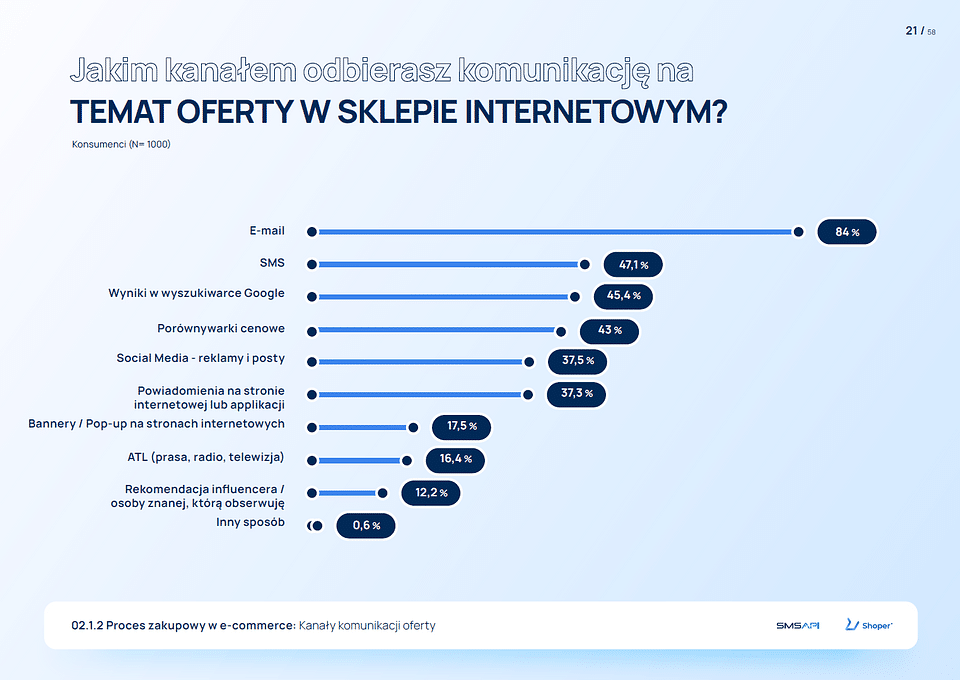
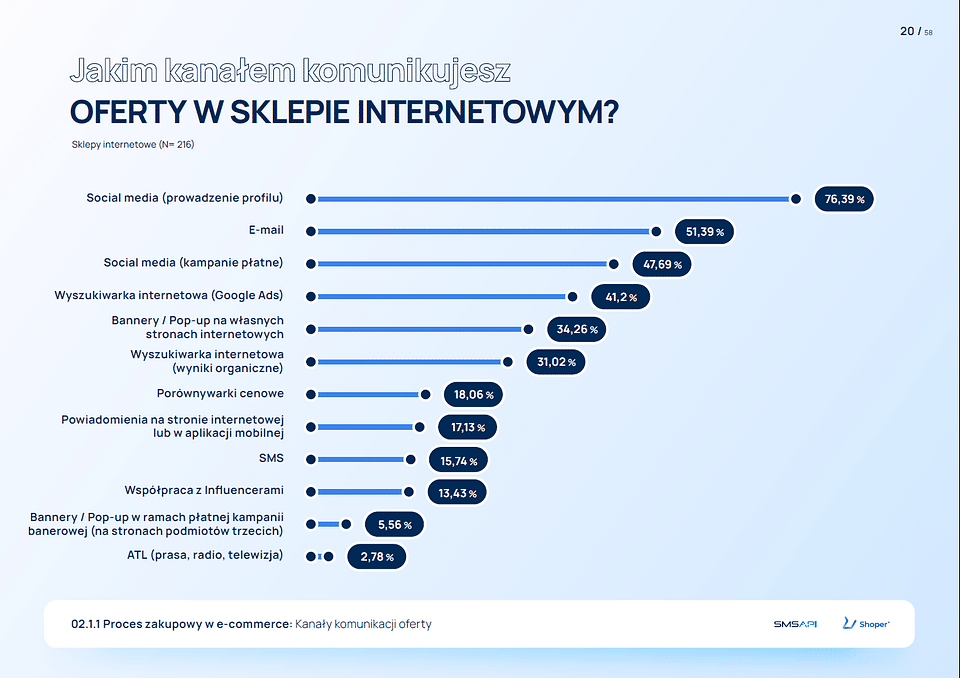
More than ¾ of online stores promote their offer on social media. Meanwhile, for buyers, the channels for discovering shopping offers are, in order: email, SMS, Google search, price comparison sites, and only then social media — with a result of 38%. The new report "Online Store Communication" from SMSAPI and Shoper examines online shopping from both the seller's and the consumer's perspective. For owners, it's a concrete hint about what e-stores can improve in their communication with customers.
Contact channels that customers want
SMSAPI and Shoper jointly prepared a unique report "Online Store Communication" based on two opinion surveys. In the first — consumer — survey, 1,000 people were asked to talk about their experiences and preferences regarding online shopping. The second part of the data comes from a survey of a group of 216 sellers.
Both buyers and e-store owners were asked about the same issues. On certain points, both sides agreed; on others, they differed. The discrepancies discovered in several places can give sellers plenty of ideas on how to reach customers more effectively.
What we learn about online buyers:
- They need 2 hours to find and purchase the product they need (88% of responses)
- They prefer to receive promotional offers on their phone (59% of responses)
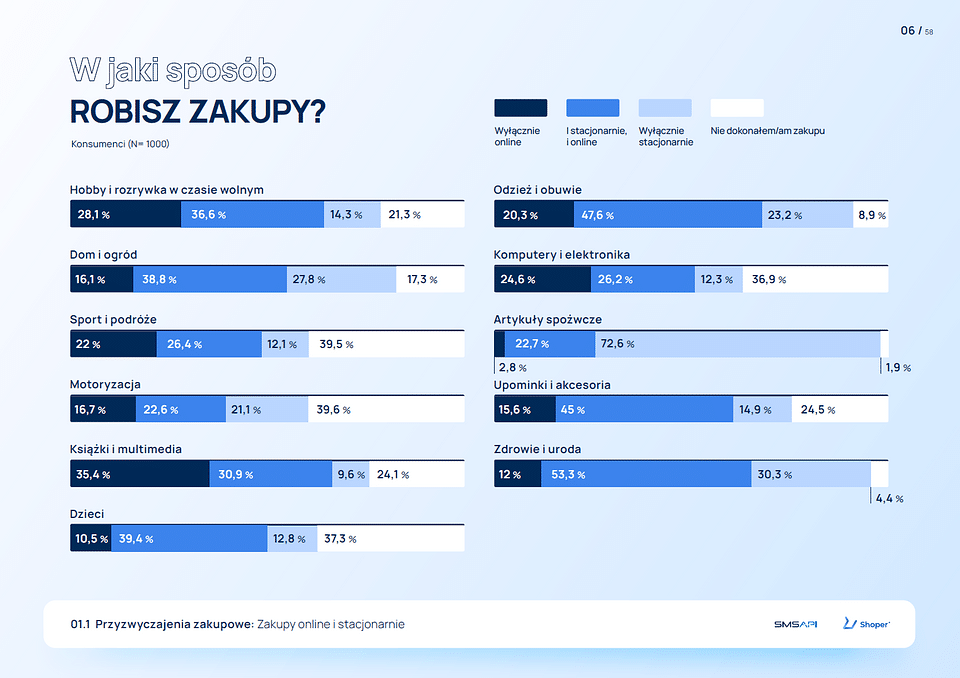
- During the pandemic, they started shopping online more often; most commonly cosmetics (34%), clothing (34%), books and multimedia (31%)
- They want to be informed about order progress; preferably by email (52%) or SMS (35%)
- They share personal data; most often gender and first name (78% each), least often income (13%) and phone number (23%)
- In recent months, online traffic has increased, the number of transactions has grown, and with it revenue in e-commerce. The industry has gained momentum. Our study shows that in this "new normal," success will be achieved by those e-commerce businesses that effectively compete for customer attention and take care of the shopping experience. However, this will not be possible if stores do not know what consumers themselves expect. After all, it is they who receive offers, react to promotions, add products to carts, and often harshly judge any missteps. We see, among other things, that they buy everyday products online much more often, decide faster, and would gladly complete the entire purchasing process on their phone. Sellers should find an answer to each of these trends - suggests Maja Wiśniewska, PR & Content Marketing Manager at SMSAPI.
What we learn about online sellers:
- They most willingly promote their offers on social media (76% free / 48% paid) and in newsletters (51%)
- Only 18% personalize the offers sent to customers, although it is worth noting that 53% intend to introduce personalization soon
- To build their customer contact database, they use a module on the store's homepage (72%) or at checkout (62%)
- Half (52%) use back-in-stock notifications, sending them most often by email (78%)
- 97% try to encourage customers to return, and half (48%) use remarketing
- All customers love promotions, but not every seller operates in an industry with high margins that can easily be reduced by offering discounts. This does not mean, however, that they are in a losing position, because what customers value just as highly as attractive prices are positive sales experiences and clear communication. The former may include, for example, offering free delivery and convenient payment methods. In turn, personalizing offers, which sellers are increasingly embracing, promoting them first in newsletters and other channels that customers have subscribed to, and efficiently guiding buyers through the purchasing process - naturally builds a base of satisfied customers and encourages positive recommendations online. The report shows that sellers have a whole set of tools at their disposal here, and many of them are already using them - notes Oliwia Tomalik, Marketing Manager at Shoper.
A picture of the industry at an important moment for it
A picture of the industry at an important moment for it
The study shows that after pandemic increases, there are already several retail sectors in which the share of online buyers reaches 65% (e.g. Hobby and entertainment, Computers and multimedia, Health and beauty), as well as several such as (e.g. sports and computer) where nearly one in four consumers already buys exclusively online.
The report - full of suggestions for sellers - is published just before Black Friday 2020 and at the start of the holiday shopping season. The share of online purchases during this period will probably be historically high. REPORT


