
In the first half of this year, there were generally 15% fewer promotions in stores than a year ago. The largest decline, close to 80%, was recorded by stores selling children's products. Large declines were also seen in electronics and home appliance chains – over 40%, as well as hypermarkets – almost 30%. Smaller reductions were made by drugstores and pharmacies, cash&carry, supermarkets, and convenience stores. Increases below 10% occurred only in discounters, DIY chains, and wholesalers. Only stores in the culture and entertainment category maintained last year's level. These conclusions come from a report by the AdRetail Group Analysis Center, Hiper-Com Poland, and UCE RESEARCH.
From an analysis of over 2.3 million promotions, it appears that in the first half of this year retail chains overall ran 15% fewer promotions in their leaflets than in the same period of 2019. As Andrzej Wojciechowicz comments, in the fourth quarter of last year chains may have agreed with manufacturers on a promotional plan similar to or even richer than the year before. However, they had to limit the number of campaigns due to the pandemic, lockdown, and the shift of a significant portion of sales to e-commerce.
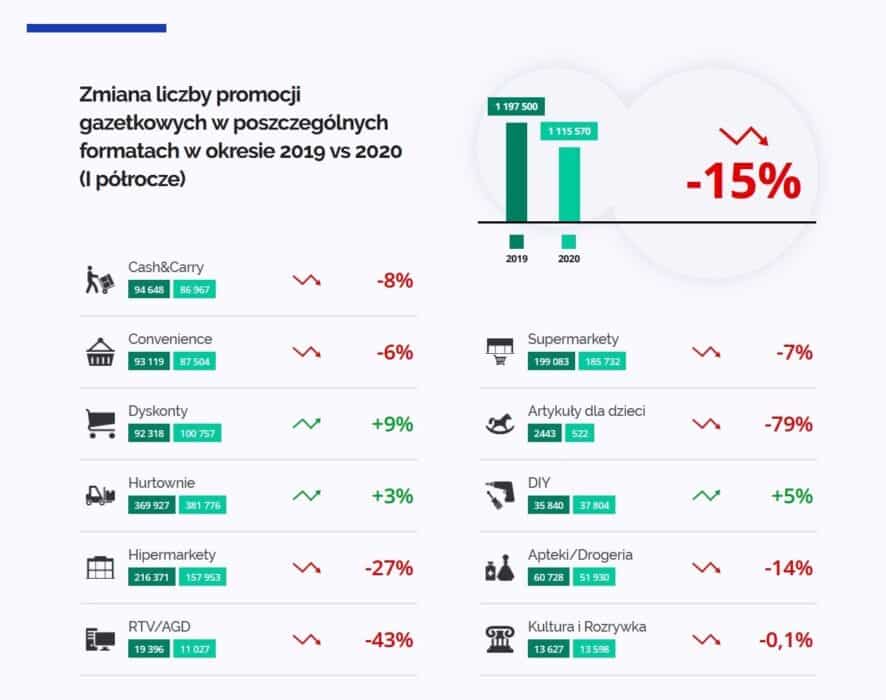
– Taking into account all the challenges that no one in the industry expected a year ago, an overall reduction of 15% seems substantial. However, to assess it unequivocally, one should look separately at the situation of each sales channel. What is undeniable, though, is that the lockdown played a large part in this – emphasizes Karol Kamiński, Chairman of the Chapter of the AdRetail Inspirio Program.
Which categories suffered the most?
The largest declines were recorded by children's product stores – 79%, as well as chains offering electronics and home appliances – 43%. Third place went to hypermarkets – 27%. Then came drugstores and pharmacies – 14%, cash&carry – 8%, supermarkets – 7%, and convenience chains – 6%.
– The decline in promotions in children's stores resulted from the fact that Poles shifted their purchases to discounters. Their offers are just as attractive as those of specialty chains. Consumers can buy products for children while doing their everyday shopping, reducing the number of places they visit. During a pandemic, this is of significant importance – explains Dr. Urszula Kłosiewicz-Górecka.
Why did hypermarkets lose out?
Consumers mainly focused on buying essential products, as another expert, Dr. Maria Andrzej Faliński, emphasizes. The reduction in purchases in categories such as toys or electronics and home appliances resulted in narrower promotions. Costly campaigns could do little in this situation, so they were abandoned. The position of hypermarkets, which offer a very wide assortment, also declined because customers were not interested in it.
– The difficult situation of hypermarkets had been visible for some time. The pandemic only sharpened it. During the pandemic, customers drastically limited visits to large-format stores. They were simply afraid of virus infection. They preferred to go to smaller outlets – recalls Karol Kamiński.
Who benefited from the pandemic?
How did the pandemic affect promotions in stores?
In turn, the largest increase was recorded by discounters – 9%, followed by DIY stores – 5%, and wholesalers – 3%. In stores in the culture and entertainment category, nothing changed. Meanwhile, Yves Frerot of Hiper-Com Poland notes that during the national quarantine, stores relatively close to the consumer gained a clear advantage. In this case, discounters led the way. However, we heard a lot about home renovations due to the situation. And that could have influenced the results of chains in the DIY industry.


