
A company's or brand's reputation is only half shaped by what consumers know about its services and products. To the same degree, trust in a given company is determined by its environmental impact and the actions of its CEO and management board. Although companies are increasingly engaging in solving social problems, they do not necessarily do so in line with consumer expectations. The greatest engagement is expected by young people and seniors. These are the conclusions of the latest Authenticity Gap report prepared by the PR agency FleishmanHillard.
When companies lack authenticity
When companies lack authenticity
Being "authentic" is one of the main consumer expectations of companies. The consistency of actions with declarations and business engagement in issues important to consumers increasingly affect how brands are perceived. Authenticity Gap examines three interconnected reputational areas of a company: the behaviour of the company's management, the social dimension of its activities, and the benefits for consumers. The Authenticity Gap study also answers the questions: which problems are currently important to societies, which of them should business engage in solving, and to what extent brands meet social expectations.
- Authentic companies are those that maintain a balance between social expectations of the brand and the actual experiences of customers. The emerging discrepancy, i.e. the so-called authenticity gap between expectations and experiences, can have various causes: from misidentifying consumer expectations, through taking misguided actions, to insufficient communication – explains Wojciech Waglowski, managing director of the Warsaw office of the PR agency FleishmanHillard. - In the event of a large discrepancy, analysing and understanding its causes and correcting actions are essential in working towards the desired image of the company.
Social impact increasingly important
Social impact increasingly important
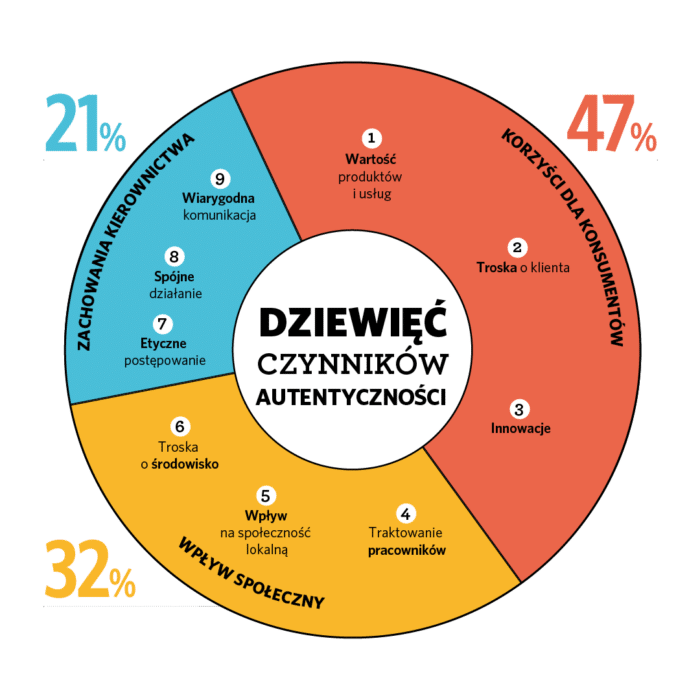
As research shows, today customer benefits and the features of a specific brand's products and services shape its reputation by only 47 per cent. Back in 2017, this figure was 53 per cent. The opinion of a brand is influenced by management actions to the extent of one fifth (21 per cent) (in 2017 it was 24 per cent). Over the past four years, the greatest increase in importance for reputation was recorded in the area of social impact, which consists of elements such as care for the natural environment, treatment of employees, and relations with local communities. Since 2017, the importance of these factors in the perception of companies has grown by almost one third – from 25 per cent to 32 per cent.
Consumers expect real responsibility
Consumers expect real responsibility
FleishmanHillard also asked consumers** which social problems they currently consider most important and which of them business should engage in solving. At the top of the ranking of the most important social problems, respondents placed issues of data security and privacy (deemed "very important" by 57 and 55 per cent of respondents respectively). Next in line were access to public services – healthcare (54 per cent of indications) and education (50 per cent). In sixth place was freedom of speech (48 per cent), and in eighth place (47 per cent) – climate issues. The ranking is closed by the issue of racism (twelfth place and 42 per cent of indications as "very important") and the issue of the minimum wage (thirteenth place in the ranking, 41 per cent of indications).
The top of the ranking of problems that, according to consumers, business should engage in solving looks similar. In the first places we also find issues of data security and privacy (48 and 47 per cent of indications respectively). However, access to healthcare already took tenth place (32% of indications), and access to education did not even make the list. In consumers' opinion, business's task is not to fight for freedom of speech, which – although assessed as an extremely important problem – found itself in thirteenth place in the ranking (third from last, 31 per cent of indications). According to consumers, companies should deal with environmental protection, the minimum wage, income inequality and racism (subsequent positions in the ranking from 3 to 6 with 44, 40, 38 and 33 per cent of indications respectively).
- Consumers very accurately assess what business is responsible for and what it is not. They hold companies or brands accountable for what they actually have an influence on: protecting their privacy, their impact on the natural environment, wage levels, and a friendly, inclusive work environment – assesses Wojciech Waglowski of FleishmanHillard. - This is very good news for those companies that want to take real responsibility for their actions, take concrete steps to that end, and are able to communicate them properly to customers. The Authenticity Gap method can be a helpful signpost for companies as to what they should do to meet consumer expectations.
What should a CEO do?
What should a CEO do?
Although the importance of management's stance in shaping the image of companies and brands is slightly declining, expectations of CEOs remain high. As many as 65 per cent of respondents believe that CEOs should speak out on matters that may not have a significant impact on the company but have a significant impact on society. 73 per cent of respondents indicated that business leaders should show engagement in the area of environmental protection. A similar proportion (72 per cent) pointed to issues of equality, diversity and social inclusion, and 65 per cent of respondents want company CEOs to influence health policy.


