
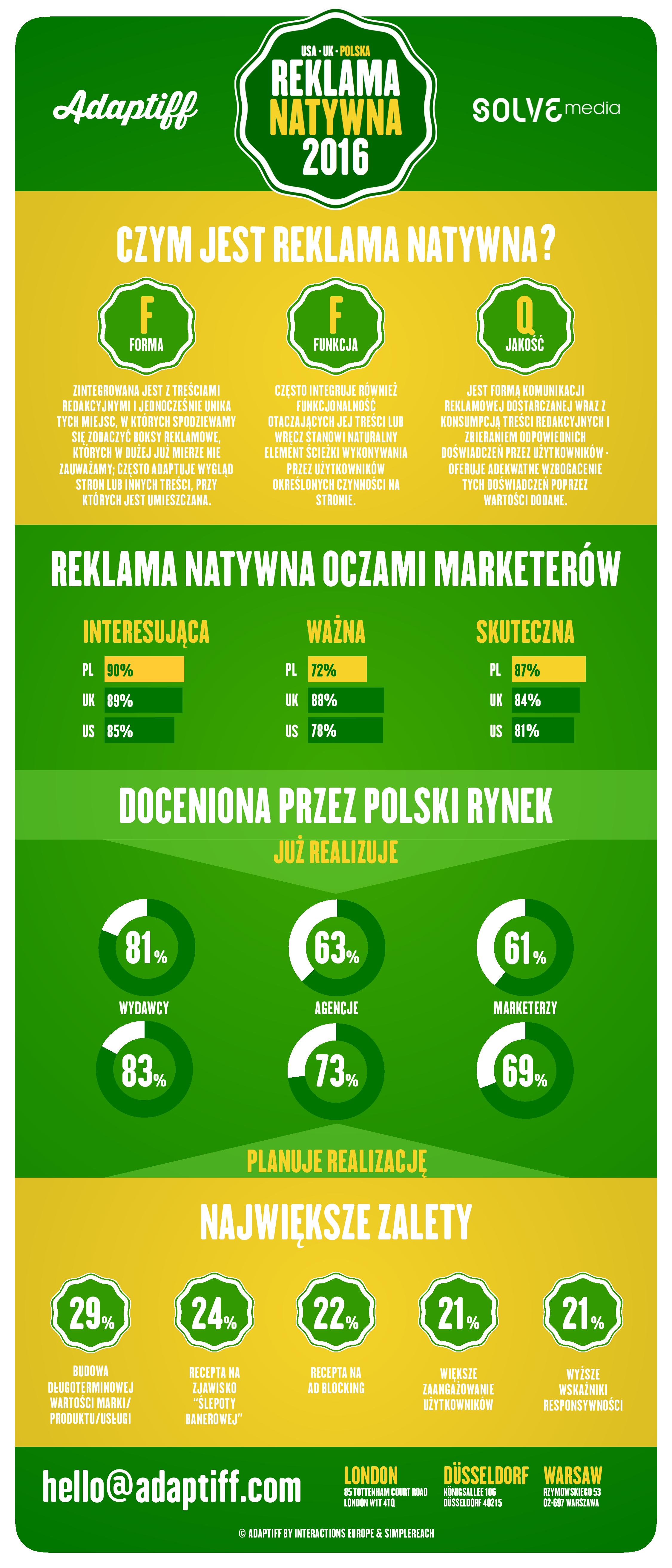
European native advertising network Adaptiff (a brand under Interactions Europe) conducted a survey among marketers, media house representatives, and publishers regarding native advertising. For the first time, the scope was this broad, covering three major markets: North America (USA), Western Europe (UK), and Central and Eastern Europe (Poland).
Based on collected data, Adaptiff and Solve Media, Inc. prepared the cross-continental report “Native Advertising 2016 USA - UK - Poland”. The study illustrates how representatives of these three markets perceive native advertising, how they define it, what they consider its strengths and weaknesses, how they use it in their own activities, and how they assess its future.
Three markets, one definition?
Although all respondents agreed that native advertising is an effective alternative to traditional online advertising, detailed analysis of answers revealed sometimes significant differences between the three markets. One such area is willingness to adopt new solutions and technologies. The most open in this regard was the American market (with the longest history of native solutions), while the UK market was the least open. Polish respondents’ indicators are closer to U.S. results, suggesting that Polish marketers and agencies already place high hopes in native communication and are largely ready to adapt new solutions—especially evident in the responses of Polish publishers.
Barriers: measurement and time-consuming nature
Another difference between the three markets is the perceived barriers limiting wider adoption of native advertising. For Polish respondents, the most frequently cited obstacle is the lack of standardized performance measurement (33%), whereas in the USA, the issue is much rarer (17%). Domestic market representatives also highlight the time- and labor-intensive nature of using this form of communication (28%), compared to only 4% in the USA. These challenges can be addressed by technology in the form of campaign management applications and data analytics tools—of which the American market is far more saturated.


