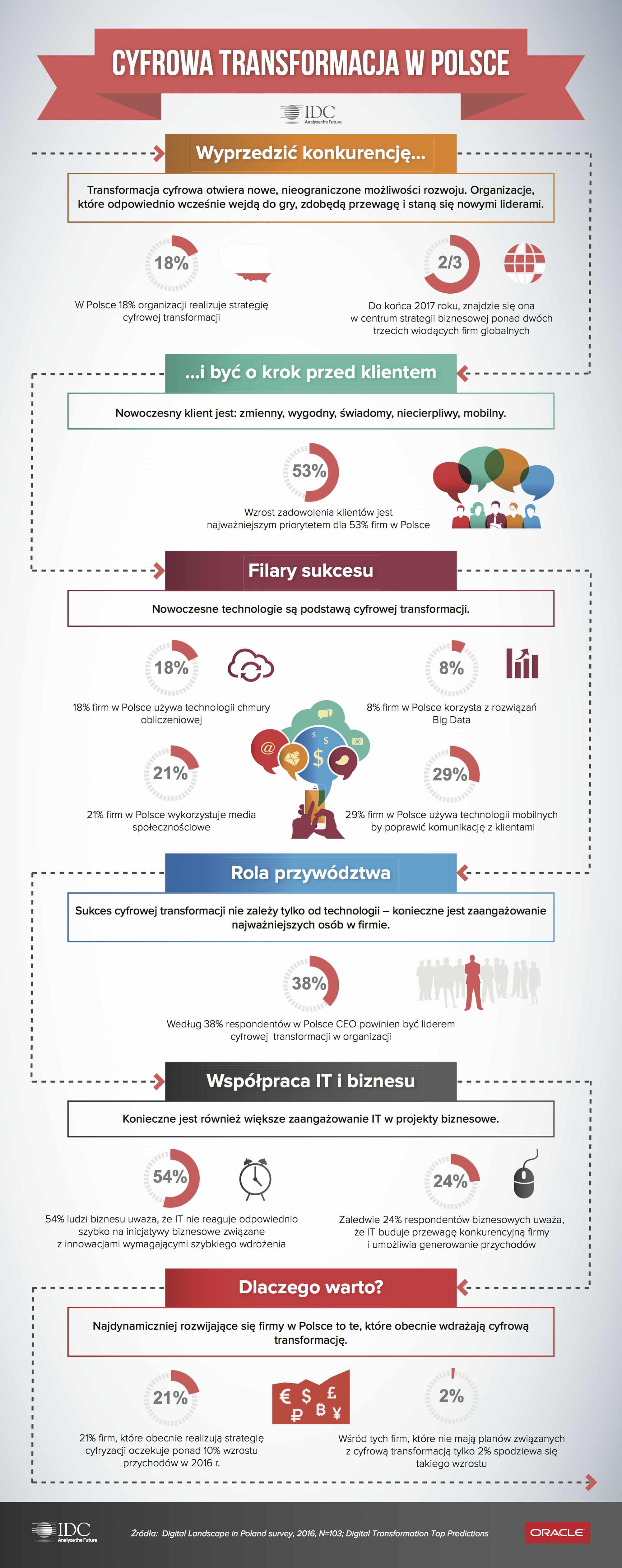
More than half of Polish companies consider improving customer satisfaction their top priority. That's according to research conducted by the analytical firm IDC on behalf of Oracle. The problem, however, is that at present Polish enterprises generally lack the technologies needed to support their marketing efforts. Only one in five surveyed companies is actually pursuing digital business transformation.
IDC, commissioned by Oracle, asked Polish companies about their business priorities over the next 12 months, as well as their planned investments in new technologies that would enable their marketing activities. The focus was on technologies widely regarded as pillars of digital business transformation: cloud computing, mobile technologies, and Big Data analytics. These three areas are today the basis for companies to understand customer needs and serve as fuel for creating new products and business strategies.
– Theoretically, the results of our study are positive, because Polish companies see significant potential in improving customer satisfaction. But the devil is in the details. When we look at how companies around the world think about marketing or digital transformation, it quickly becomes clear that the distance separating us from the leaders is quite substantial. Fortunately, however, it is not impossible to close – notes Piotr Witczyński of Oracle.
They want to, but they can't
They want to, but they can't
More than half of Polish companies (53%) consider improving customer satisfaction their most important priority over the next twelve months. It turns out that in most cases these are empty declarations, impossible to fulfill due to a lack of appropriate tools. It turns out that only 29% of surveyed enterprises from Poland currently use mobile solutions to improve customer service, and just 21% use social media for this purpose. Only 8% of enterprises use cloud computing. The same number of companies use Big Data solutions.
– These data show that the vast majority of surveyed companies are not keeping up with technological changes. They most likely don't know their customers well and therefore are unable to meet their needs. In practice, this means that enterprises cannot effectively compete with those companies that began their digital transformation processes earlier and are thus able to create new services faster and more cheaply – notes Edyta Kosowska of IDC.
According to IDC analysts, by the end of 2017 digital transformation will be at the center of business strategy for more than two-thirds of leading companies worldwide. In Poland, however, only one in five companies (20% of respondents) is currently pursuing business digitalization processes. And although another 8% of companies declare that they will soon begin such processes, currently as many as 54% of respondents have no plans related to digital transformation.
– In digital times, the customer is becoming increasingly demanding, especially when it comes to interactions with the seller. He knows perfectly well what he wants and expects an immediate response. A company that fails to meet this challenge and does not engage in digital transformation will sooner or later disappear from the market – notes Piotr Witczyński of Oracle.
Chasing the leaders
Chasing the leaders
Although in terms of using new technologies in companies Poland lags behind Western European countries, there is also good news. More and more companies are planning to implement such technologies or are looking at them with interest. Digital transformation is planned by 19% of Polish companies. According to IDC data, as many as 39% of enterprises are considering implementing cloud computing, and 14% are leaning toward implementing mobile technologies. That is almost as many as the number of enterprises considering or directly declaring implementation of Big Data solutions (14%).