
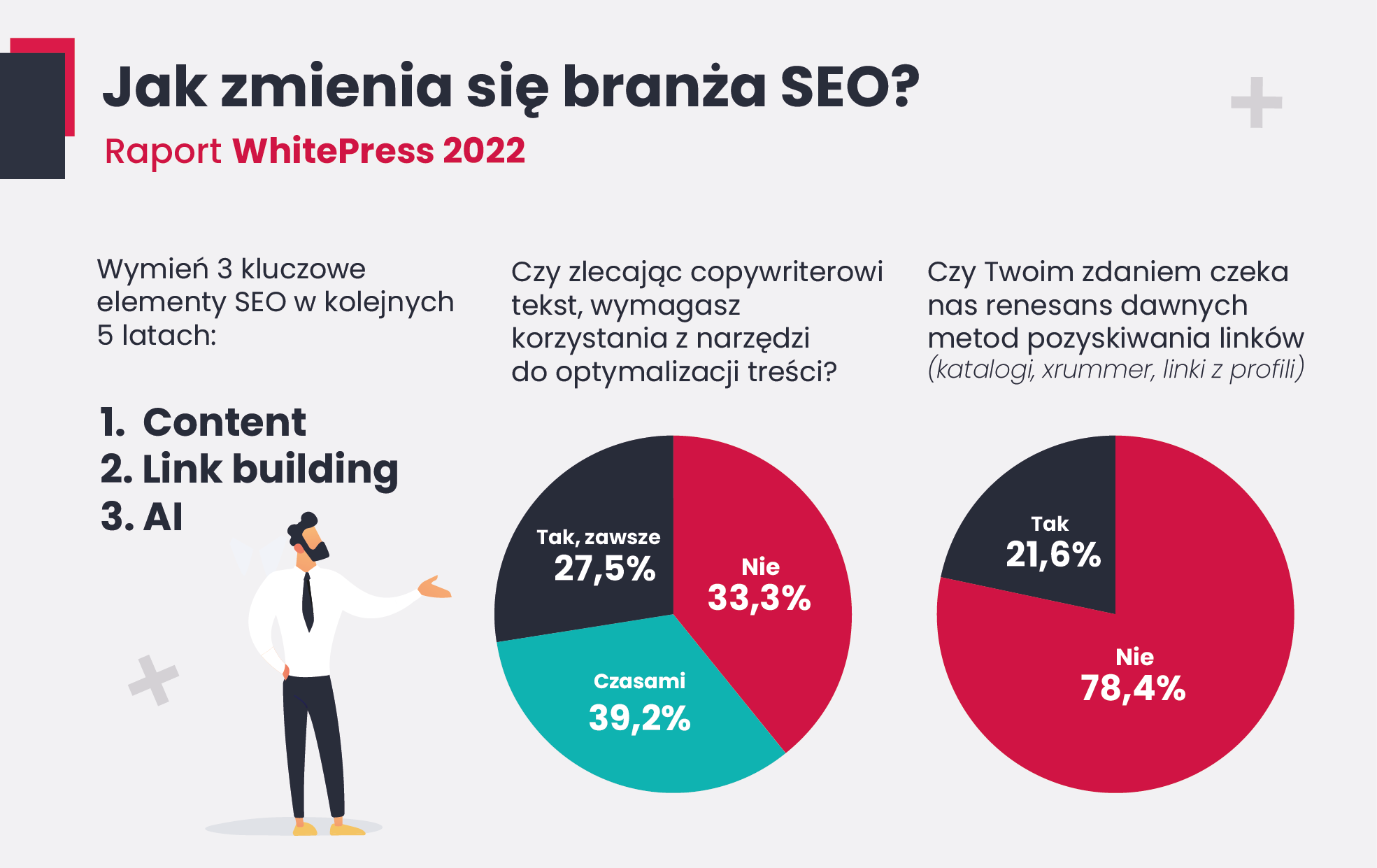
The SEO industry is taking a big step toward... the user. And although for an individual this step may still seem inconspicuous and unnoticeable today, in the SEO area it has caused quite a stir and often thorough transformations in strategies for this year. Changes are no longer focused only on increasing a site's value to "score points" with Google's robots. We are going a step further. The starting point today is the user, their impressions, intent, needs, and their context. That is why, when WhitePressÒ asked experts at the SEO & Content Camp conference organized in the middle of the year about the key elements for the next 5 years, they primarily pointed to three of them: smart content, smart link building, and of course AI. What connected the answers was, among other things, the behavioral aspect of these activities. How is the SEO industry changing in this area, and what other elements did experts point to?
The Starting Point – the User
The Starting Point – the User
In the 1990s, no one probably suspected that SEO (Search Engine Optimization) would become one of the more popular activities carried out online. Along with the development of internet search engines, the idea of website optimization also matured. Once, SEO activities focused on only a few levels. Many factors were not taken into account, including the usefulness of a domain for users, semantics, or page loading speed. For this reason, internet users often received imprecise or inadequate search results. After Google introduced its algorithms, a ranking system was created that made it much easier to find the most popular, credible, and valuable content for audiences. Today, when positioning websites, we emphasize far more elements than just a site's value from the point of view of Google's algorithms. The audience, their impressions, the quality and uniqueness of the message also matter – perfect matching to them and being two steps ahead of their intent.
- In the study, we asked an open question requesting the 3 main trends that, in experts' opinion, would dominate the SEO industry over the next few years. The answers varied, but at the same time 3 elements appeared very often – valuable content, valuable link building, and artificial intelligence. All these factors share one common goal – to hit the user's intent flawlessly through quality activities. This is very difficult, if not the most difficult task facing the entire industry, but every year we improve tools and mechanisms, including within these three elements. In addition to these trends, the SEO specialists and marketers who took part in our study also pointed to other important aspects, such as UX and SXO, Core Web Vitals, and constant alignment with Google's algorithms. All of this has a huge impact on the results of positioning activities – comments Patrycja Kosek, Head of Marketing & PR, ÒWhitePressÒ
1. Smart Content – Not Quantity but Quality
1. Smart Content – Not Quantity but Quality
In online marketing activities and the SEO industry, content is taking on a completely new meaning. Uniqueness, credibility, and quality are now the benchmark and condition without which brands have no chance against the competition. Google updates, such as BERT or MUM, aim to match content in search as well and accurately as possible. Websites providing information in an original form, specific and without unnecessary generalities, may be noticed faster by Google's robots. It is possible that keywords will give way to content quality, its clear form, and matching to the recipient's intent.
According to Paweł Sokołowski, president of Contadu, speaker at the SEO & Content Camp conference: - The trend related to creating qualitatively good content will continue. This means that it is better to do it well than to do a lot. This has been visible for several years and will still be very important. Google's algorithms like quality content and rate it highly. Therefore, by writing so-called "thin content" (low-value content), we will not build long-term traffic.
Patrycja Kosek adds that the concept of topical authority, which assumes building the position of an expert in one's field, is gaining popularity in the world of SEO. – How to do this? A broad thematic approach when creating content, deepening or comprehensively covering a given problem, is the key to obtaining a better position in Google. It can be risked that content usefulness is the future of intelligent positioning.
2. Link Building – Topical Linking
2. Link Building – Topical Linking
Over the years, the importance of backlinks for website positioning has not changed, only the way they are generated. The times when linking from directories or writing texts saturated with keywords was enough are gone. For years, the emphasis has been on the quality of links and their topical connection, that is, ensuring that the link comes from a valuable site and is related to articles that refer to what the brand does. This increases the usefulness of the site and allows it to compete for a place in the SERP. Well-matched links also increase the chance that we will increase our site's organic traffic.


