
The pandemic has caused not only changes in the economy, but also in citizen–state relations. Societies began to demand that governments above all protect citizens' health and provide livelihoods. At the same time, states had to increase their activity in digital channels to reach the widest possible group of citizens with information.
Lower trust in governments
According to EY's global study "How a digital government can connect all citizens," only slightly more than half of respondents (53%) believe that governments are effectively using technology in the fight against the coronavirus. Nearly one-third (32%) treat digitalization in public services as one of the three most important priorities if governments want to improve their quality.
[caption id="attachment_195269" align="alignnone" width="1049"]
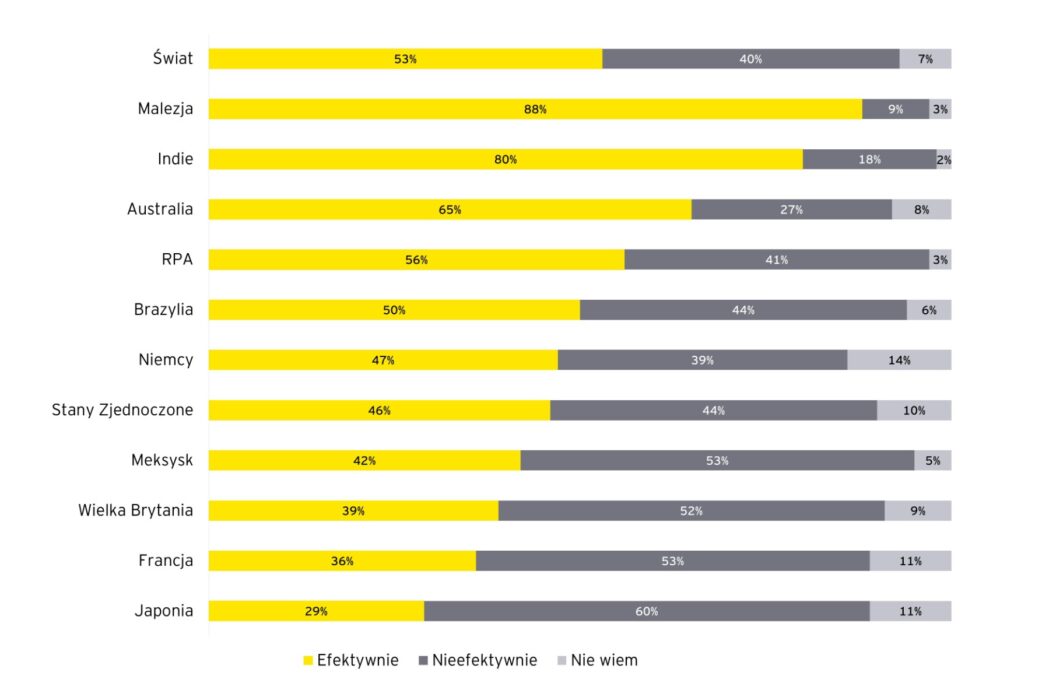
How effectively are the government and public sector using digital technology to fight the pandemic?[/caption]
- Our research and experience from recent months allow us to expect a further increase in the importance of technology, also after the pandemic ends. The private sector realized this very quickly and emphatically, and without delay and as quickly as possible – as far as an industry where this was possible is concerned – moved its operations to digital channels and is still improving its products and services and building positive customer experiences in these channels. Governments have fallen somewhat behind in this competition, although it must be remembered that process changes in this particular area do not proceed – and by their very nature will not proceed – as quickly as in the private sector. Nevertheless, both from the global study and from Polish surveys – for example, those conducted jointly by EY and Billennium – it follows that citizens had problems accessing public services. In our study, 23% of respondents indicated problems with the closure or restriction of access to offices, the Social Insurance Institution or the labor office – that is nearly one in four citizens. Also interesting, more than half of respondents would willingly handle official matters online, without the need to visit an office. This is one of the most frequently indicated, most popular activities that Poles would gladly move to the online channel – says Marcin Bartoszewski, EY Poland Consulting Innovation Leader.
Concerns about growing inequalities
How is technology in the fight against the pandemic changing citizen–state relations?
Digitalization of the state, however, brings not only benefits but also challenges. Although 72% of those surveyed by EY believe that technology improves quality of life, along with the development of state-citizen communication in digital channels, they fear deepening social inequalities (32%), increased power in the hands of those who already have it or are wealthy (34%), while 32% believe that technology will worsen relations in communities. Nevertheless, there is a need to develop digital skills. 61% of respondents declare that they would use government training programs if they were available.


